Boards, Blind Spots and AI

Whilst undertaking my Non-Executive Director Diploma with the Financial Times last year, I was struck by the sheer number of corporate failures that could have been identified earlier, contained more effectively, or in some cases avoided altogether through stronger board oversight.
While we have all seen the headlines — Theranos, the UK Post Office, Credit Suisse, Silicon Valley Bank — what stood out to me was how many opportunities there had been for boards to exercise their oversight responsibilities earlier and more effectively.
These cases may be extreme, but they point to broader weaknesses in board effectiveness. PwC’s 2025 Annual Corporate Directors Survey found that more than half of directors believe at least one fellow board member should be replaced, with the top reason being that they do not contribute meaningfully to board discussions (2025 PWC Annual Corporate Directors Survey PWC).
However, there are many challenges facing boards, which can form part of the reasoning for the gaps in performance. They can be summarised as:
- The acceleration problem: Technology and regulation are evolving at a speed that makes it increasingly difficult for boards to stay current across all relevant developments. In fact, in PWC’s Annual Corporate Directors Survey digital transformation, AI and regulatory changes were listed as 3 of the top 4 areas directors felt their board should spend more time on over the next 12 months.
- The expertise problem: Boards cannot realistically hold deep expertise across every area they are expected to oversee. This has been evident in domains such as cyber and ESG, and is now particularly visible in AI. Boards have a finite number of seats, which makes choices about composition important — but also makes it critical to find practical ways to augment expertise gaps when they arise.
- The information problem: Boards are responsible for oversight, but they do not operate with the same level of visibility as management. They are typically reviewing a curated snapshot of the business rather than the continuous flow of detail beneath it. That is appropriate — boards are not there to run the company day to day — but it can make it much harder to identify emerging issues before they become more serious problems.
- The challenge problem: Boards are expected to challenge management and one another constructively, but in practice board culture can favour collegiality over scrutiny. Directors operate in environments where consensus is valued and relationships matter, which can make challenge feel uncomfortable or disproportionate. The result can be a board that appears constructive and functional, but asks too few difficult questions.
- The self-governance problem: Boards are expected to govern risk across the organisation, but often apply less rigor to governing the risks within the board itself. Most companies maintain detailed processes for monitoring business risk; far fewer assess board capability gaps, blind spots, decision quality and challenge dynamics with the same consistency. Yet those factors can be decisive in whether issues are surfaced early or missed until much later.
Contemplating these issues, I became increasingly convinced that AI could provide practical support across many of them. Despite the practical opportunities, adoption remains limited. PwC’s Annual Corporate Directors Survey found that only 7% of boards are using AI to enhance governance, while 65% have not integrated AI into their board activities at all.
There are a number of ways that I see AI bringing practical support to boards:
1. Meeting preparation: The most immediate opportunity is using AI to summarise and interrogate board papers. Boards should have access to safe tools and environments for this, making it much easier for directors to prepare thoroughly and identify where they need to dig deeper.
2. Keeping abreast of technology and regulatory changes: AI can also help boards stay current on fast-moving developments. Directors can now use relatively simple tools to build tailored briefings on regulatory, technological and market changes relevant to the organisations they govern.
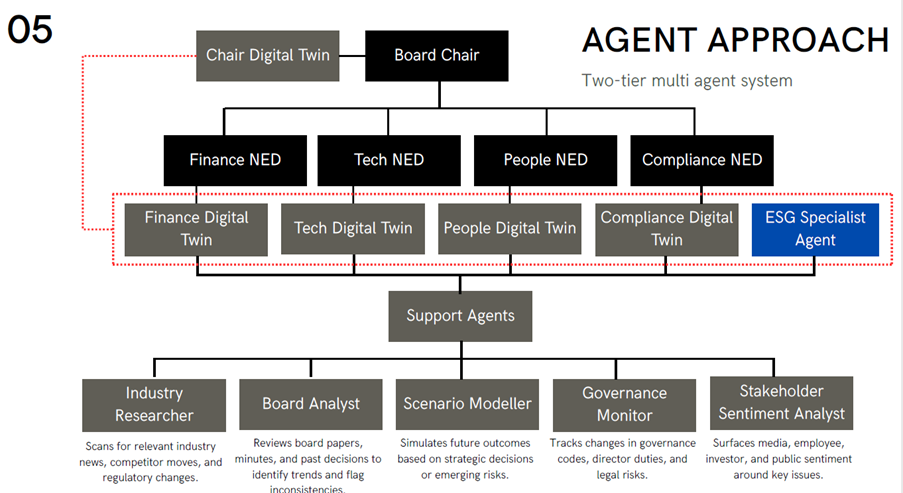
3. Digital twins as a second set of eyes: Things become more interesting when AI is tailored to the perspective of individual board members. A digital twin, informed by a director’s areas of expertise, past contributions and previous board discussions, could help surface the parts of the papers most relevant to them, suggest where further information may be needed, and even identify the kinds of questions they would be likely to ask.
4. Identify and augment gaps in expertise: This same approach could also help the chair identify where expertise is concentrated across the board, and where meaningful gaps exist. It could provide a quick view of which directors are likely to have the strongest perspective on a given issue. And where the gap is significant, it is feasible that a digital expert — effectively a form of digital board member — could augment the board by supporting the line of questioning that ought to be brought to the table.
5. Scenario simulation and risk mitigation: AI could help boards explore strategic scenarios, test assumptions, identify potential risks and model trade-offs before decisions are made.
And there are secondary benefits to leveraging AI in board environments:
- Reduce Impact on the Executive Team: By equipping boards to a higher level of self-service, this would reduce unnecessary executive effort and reactive demands.
- Faster onboarding of new NEDs: Enable new directors to get up to speed fast with tailored briefings linked to board priorities and their expertise.
- Enhanced audit and regulatory readiness: AI can create a transparent, auditable trail of decisions, questions and oversight to support compliance reviews.
I have spent some time thinking through how this could work in practice, both at the level of the agent architecture and the user experience. I then did a bit of vibe-coding with Bolt.new and CrewAI to prototype what that might look like for an admin, a chair and a board member. It is early and rough, but it helped me get beyond the theory and see how some of these ideas might actually hang together.